

Wavy Z
Price range: $40.00 through $125.00
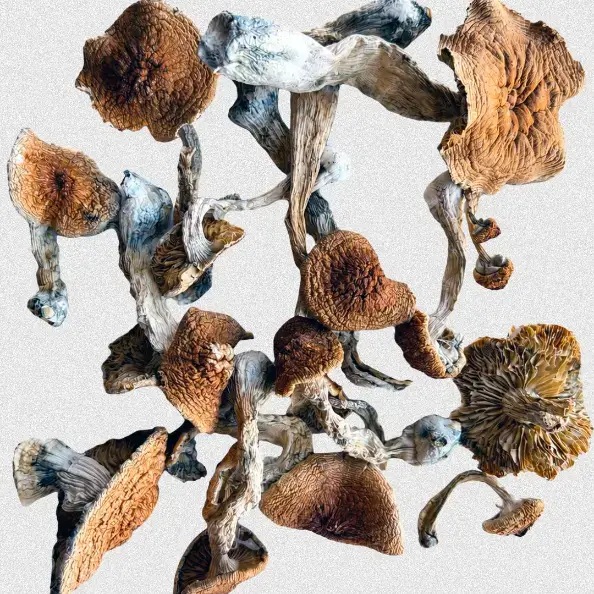
Wavy Z, is a well-known species of psilocybin-containing mushroom belonging to the Hymenogastraceae family. Named for its distinctive wavy cap margins that develop with maturity, this species is recognized for its high concentrations of the naturally occurring compounds psilocybin and psilocin. First formally described by British mycologist Elsie Wakefield in 1946, Psilocybe cyanescens has become one of the most studied wood-loving mushrooms due to its unique appearance, widespread distribution, and remarkable potency.
Species Profile
- Scientific Name: Psilocybe cyanescens
- Common Names: Wavy Cap, White Cap, Blue Halo Mushroom
- Family: Hymenogastraceae
- Active Compounds: Psilocybin, Psilocin, Baeocystin
- Growth Habit: Wood-loving mushroom
- Known Distribution: Pacific Northwest, Western Europe, New Zealand, Central Europe, and parts of Western Asia
Appearance
Key Characteristics
- Caramel-colored cap with wavy margins
- Bright blue bruising where damaged
- White fibrous stem
- Dense purple-brown gills at maturity
- Frosted appearance from mature spores
Habitat
Psilocybe cyanescens is a wood-loving species that thrives on lignin-rich materials and is most commonly found growing on:
- Hardwood mulch
- Wood chips
- Landscaped garden beds
- Mulched urban parks
- Woodland debris
Unlike many wild mushrooms, it is rarely found growing directly from soil without woody material.
Potency
Psilocybe cyanescens is widely regarded as one of the more potent naturally occurring psilocybin mushroom species.
Reported analyses have found:
- North American specimens: Approximately 0.66–1.96% total indole alkaloids (dry weight)
- European specimens: Approximately 0.39–0.75% total indole alkaloids (dry weight)
Potency can vary depending on genetics, growing conditions, maturity, and storage.
Living Characteristics
One of the defining features of Psilocybe cyanescens is its tendency to bruise blue when damaged. This coloration results from the oxidation of psilocin after the mushroom’s tissues are disturbed.
The species commonly grows in dense clusters and can rapidly colonize wood-chip beds, making it one of the most successful wood-loving Psilocybe species in urban landscapes.
Similar Species
Psilocybe cyanescens is closely related to several other wood-loving species, including:
- Psilocybe azurescens
- Psilocybe allenii
- Psilocybe weraroa
- Members of the Psilocybe cyanescens complex
Because several non-psychoactive and highly toxic mushrooms can appear superficially similar, reliable identification requires significant expertise and often microscopic examination or spore analysis.
| Weight | 1 oz (28g), 1/2 oz (14g), 1/4 oz (7g) |
|---|
Only logged in customers who have purchased this product may leave a review.
Related products
Albino Avery
In stock
Price range: $45.00 through $125.00
Penis Envy
In stock
Price range: $30.00 through $140.00
Reviews
Clear filtersThere are no reviews yet.